The one that confuses my family the most. "What the heck is a spinnaker, Annie!?"
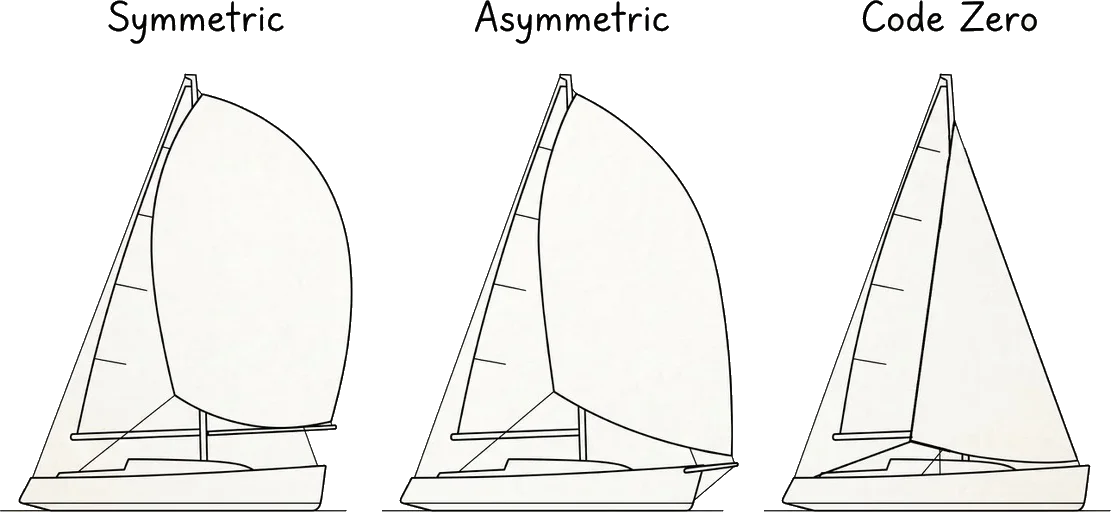
Here's the short version. They're the big kites flown from the front of the boat (often in fun colours) and are used for downwind sailing. They come in three main flavours: symmetric spinnakers, asymmetric spinnakers, and code zeros.
1. The symmetric spinnaker
This is the classic – the big balloon-shaped sail you see on traditional offshore boats running dead downwind. It's symmetric because the left side mirrors the right side: same shape, same dimensions, same everything. It's flown from a pole that pushes one corner of the sail out to windward, so the wind can blow into it square-on.
Symmetrics are brilliant in their sweet spot – true wind angle of about 150° to 180°, which is to say, the wind right behind you. They project a huge amount of sail area away from the boat and pull you downwind like a powerful parachute.
The cost is operational complexity. You need a pole, and you have to gybe it – swing it across to the new side – every time you change direction. On a short-handed boat like Employment Hero Alliance (just two of us), that's a process. Worth it on the right angle; an enormous faff at the wrong one.
2. The asymmetric spinnaker
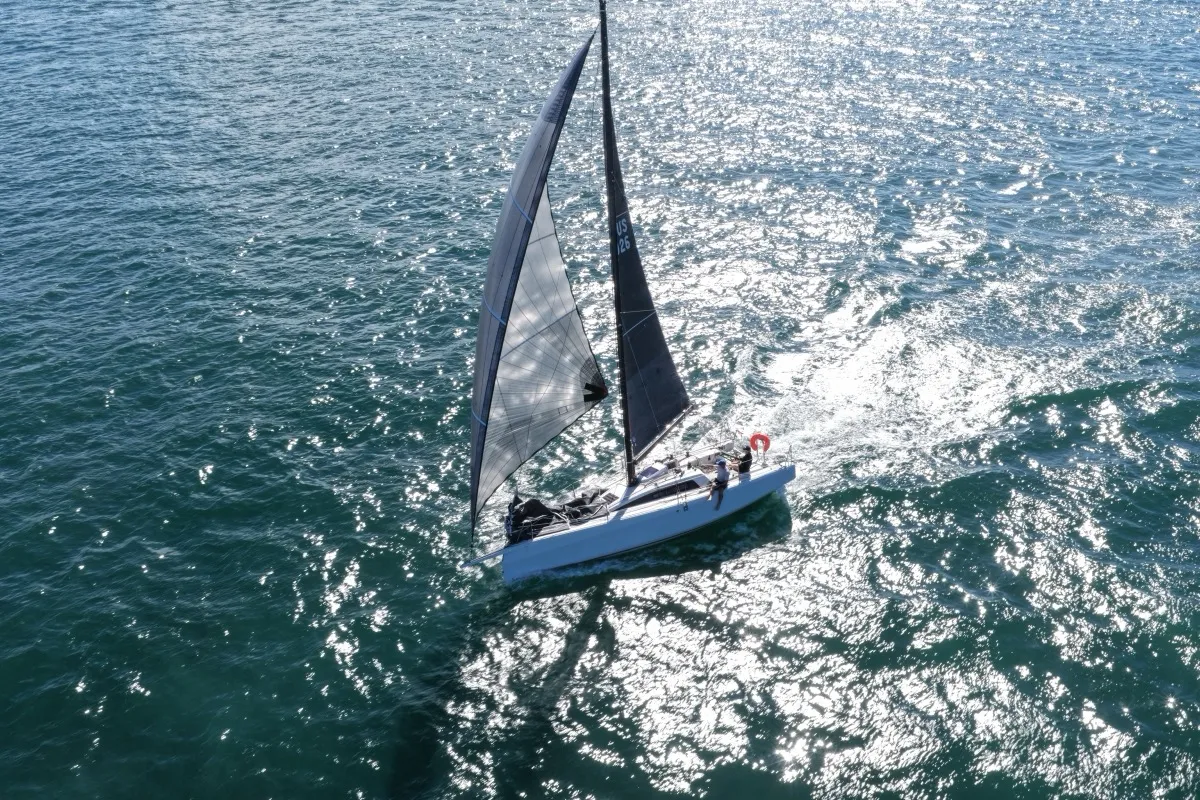
The asymmetric is what most modern racing boats – including the Dehler 30 OD (our one-design class) – use as their primary downwind weapon. It looks like a spinnaker but it's cut more like a huge, distended jib. The two sides are not symmetric: there's a luff (the leading edge) and a leech (the trailing edge), just like a normal headsail.
It flies from a bowsprit (which can be either fixed or retractable), no pole required.
The trade-off is that you can't run as deep. An asymmetric wants the wind on the side of the boat, somewhere between 110° and 150° true. To get from A to B downwind, you sail a series of hot reaches (fast, angled runs across the wind) and gybe between them – slightly more distance covered, but a lot more speed.
3. The code zero
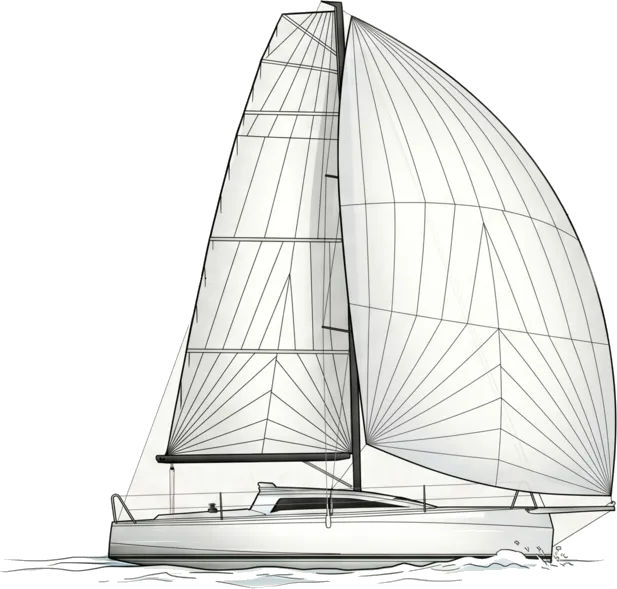
The code zero is the odd one out – the flat one. It's technically classified as a spinnaker in most rating systems, but it works like a very large, very flat genoa: it's for when the wind is too far forward for a spinnaker and too far back for a jib. Sailors give it a stack of nicknames (MH0, FR0, C0) – you can safely ignore them for now.
So which one do I use on Alliance?
The Dehler 30 OD is designed for short-handed offshore racing, and that design philosophy makes the choice for us. We carry two asymmetric sails (an A2 for lighter conditions and an A5 for heavier) and a code zero (for when the wind comes over the side of the boat). No pole, no symmetric.
Quick reference
- Symmetric – runs deepest (150°–180°), needs a pole, maximum sail area, and maximum process.
- Asymmetric – broad reaching to deep (110°–150°), no pole, and short-handed friendly.
- Code zero – close reaching in lighter air (60°–90°), flat cut, and lives on a furler.
- Rule of thumb – if you can feel the wind on your face, you're in code-zero territory; if it's on the back of your neck, you're in spinnaker territory.
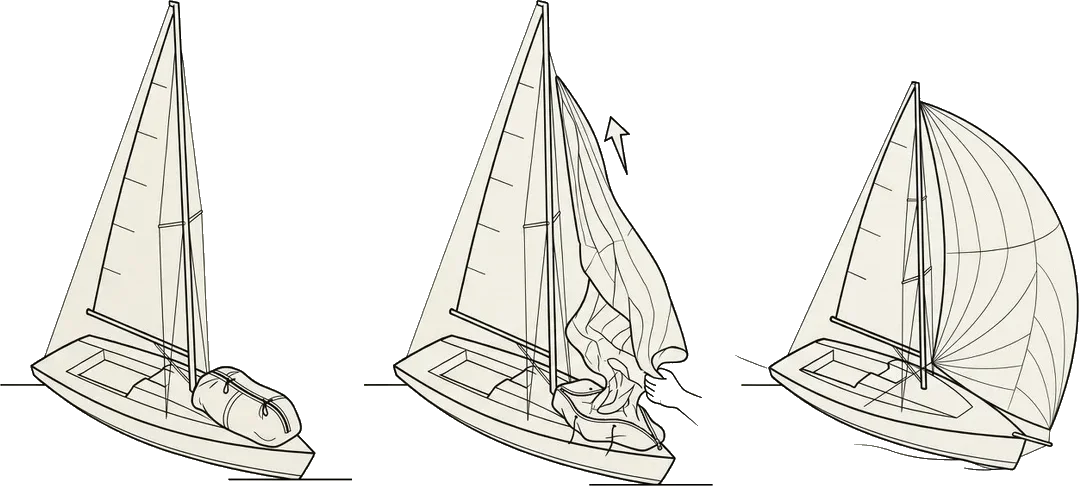
When things go wrong
Spinnakers are the most powerful and the most dramatic sails on the boat. When they go right, nothing else on the boat feels like it. When they go wrong, they go wrong fast. Knowing what can happen – and how to respond – is as important as knowing how to fly them in the first place.
The broach. This is the big one. The spinnaker overpowers the rudder and the boat rounds up into the wind, heeling hard onto its side. It usually strikes in gusts, when the helm is slow to bear away or the sheet isn't eased fast enough – the boat heels to an alarming angle, and the sail flogs overhead.
Prevention: ease the sheet in the gusts before they overpower you, bear away early, and keep the boat flat. If you do broach, dump the sheet completely – let it run – and she'll come back upright.
The wrap. The sail twists around the forestay or around itself – usually during a gybe, or in a lull when it collapses and refills twisted. You're left with a tight, useless spiral you can't hoist or drop.
Prevention: keep the sail full through manoeuvres and don't let it collapse. If it does wrap, sail deeper to unload the pressure, then unwind it slowly by sheeting from alternating sides.
The crash gybe. Despite sitting in the spinnaker section, this one's really about the mainsail. The top section of the main blows across the mast to the opposite tack while the bottom of the sail and the boom stay put on the original side. It usually happens sailing downwind in heavy air or rough seas, when the boat rolls and the top of the sail flicks across.
The blowout. High loads and ageing cloth eventually meet, and the sail tears. It usually goes along a seam or at a stress point like the clew or tack. If a spinnaker starts to rip, drop it immediately – the tear will only get bigger under load. We carry a basic sail repair kit on Alliance (sticky-back Dacron tape) that can get a torn sail back in service for light conditions, but anything structural needs a sailmaker.