Employment Hero Alliance
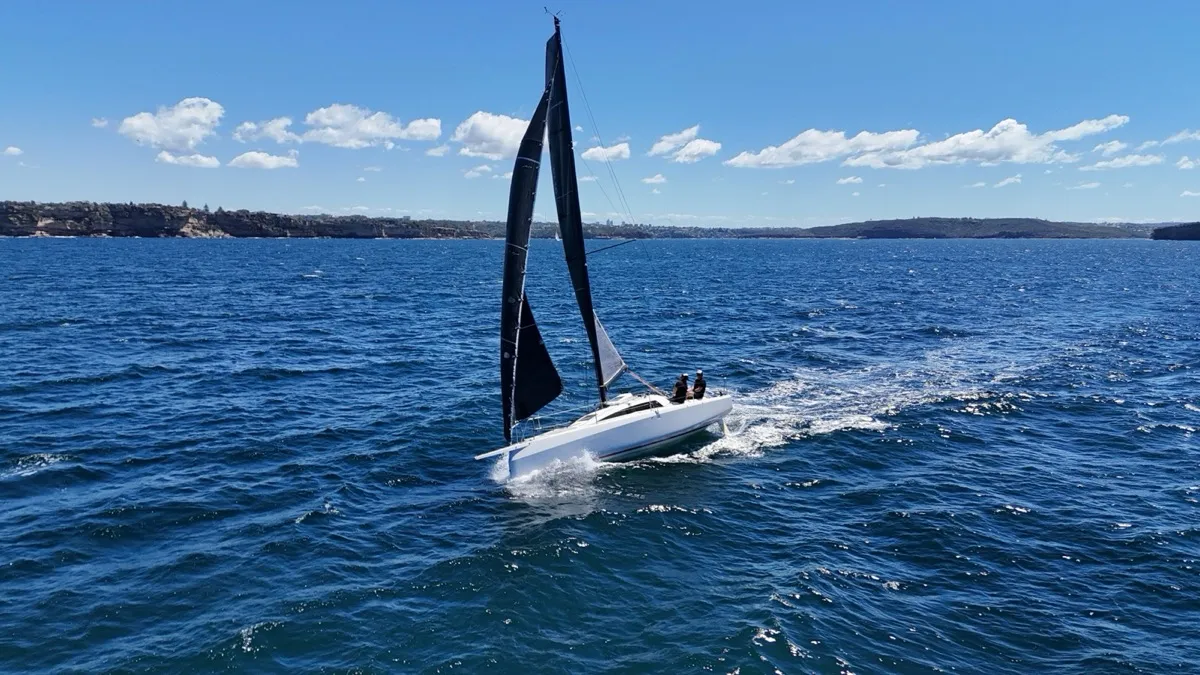
She's a 30-foot, German-built ocean racer designed for a crew of exactly two. Here she is, bow to stern.
Aerials by Stuart Don and Yoti – March & April 2026. Training on Sydney Harbour.
Dehler 30 OD.
The Dehler 30 OD was purpose-built for short-handed racing. Around 80 have been built, and they race all over the world.
What makes her different.
The Dehler 30 OD was designed by Judel/Vrolijk for one purpose: fast, safe, short-handed offshore racing.
Carbon-fibre and fibreglass construction
She's carbon where the loads are highest and fibreglass elsewhere, so she's light and stiff without being fragile.
Water ballast
We pump seawater to the high side for extra stability, and empty it when we don't need it.
Bieker Boats stealth drive
The prop folds away so it doesn't slow us down under sail.
Optimised sail plan
Her big square-top mainsail and compact set of sails are sized so two people can handle them fast.
Judel/Vrolijk design philosophy
Every line was drawn by one of the top names in racing-yacht design, for speed two people can still control.
B&G autopilot and navigation systems
The electronics hold a course and track the wind while we trim, eat or grab ten minutes' sleep.
A data platform that happens to float.
Modern offshore racing is won on information as much as instinct. Alliance carries a full B&G instrument system – a small network of sensors that streams live data to both sailors and to the autopilot, every second of every race. Here's what's going on under the deck.
Live sensor data
Sensors at the masthead and in the hull read wind speed and angle, boat speed, heading, heel, and depth – dozens of readings a second.
An autopilot that never tires
The B&G autopilot holds wind angles (true and apparent) and heading. It's closed-loop control: it reads the sensors and corrects the helm hundreds of times a minute.
Racing the boat's digital twin
Every boat has polars – a performance model saying how fast she should go at every wind angle. The goal is to chase the target speed as much as possible.
Logged, replayed, improved
Our PredictWind DataHub records every race, so we can replay the track and the numbers to see where we gained, where we lost and what to change next time.