If you're new to sailing, the number of sails on a boat can be confusing. There's a big one, a smaller one at the front, sometimes a massive colourful one that appears from nowhere, and occasionally a tiny tough-looking one that only comes out when things get serious. They all have names, they all have jobs, and choosing the wrong one at the wrong time is one of the fastest ways to get into trouble on the water.
This guide covers the sails you'll find on most modern sailing boats, starting with the ones you'll use every time you go out and building up to the specialist sails that come out in specific conditions. By the end, you'll know what each one is called, what it does, and – most importantly – when to use it.
1. The Main
The mainsail is the large, triangular sail attached to the mast and the boom (the horizontal pole at the bottom). It's the sail that's up almost all the time, and provides the majority of your driving force, especially when sailing upwind.
How it works. The mainsail is a wing. When the wind flows across it, the curved shape creates a pressure difference – low pressure on the leeward side (the side facing away from the wind) and higher pressure on the windward side. That pressure difference pulls the boat forward. It's the same principle that keeps an aircraft in the air, just rotated 90 degrees.
Key parts:
- Luff – the leading edge, attached to the mast. This is where the wind hits the sail first.
- Leech – the trailing edge at the back. Controlling the shape of the leech is one of the most important parts of sail trim.
- Foot – the bottom edge, attached to the boom.
- Head – the top corner.
- Tack – the bottom corner at the mast.
- Clew – the bottom corner at the end of the boom, where the outhaul attaches.
Controls. You trim the mainsail with the mainsheet (a rope that pulls the boom in and out) and adjust its shape with the outhaul, cunningham, vang, and traveller. Don't worry about memorising all of these right now – they're refinements. The mainsheet is the one that matters most when you're starting out. Pull it in to go upwind, let it out to go downwind.
2. The Headsails: Jib
The jib is the smaller triangular sail at the front of the boat, attached to the forestay (the wire running from the bow to the top of the mast). It works with the mainsail to accelerate the airflow between the two sails, making both of them more efficient than either would be alone.
This is called the slot effect. The gap between the jib and the mainsail creates a venturi – the air speeds up as it squeezes through the narrowing channel. Faster air over the leeward side of the mainsail means lower pressure, which means more drive. Two sails working together don't just add their power – they multiply it.
Trimming the jib. The jib has two sheets (ropes) – one on each side of the boat. Only one is active at a time, depending on which tack you're on. When you tack (turn through the wind), you release the old sheet and pull in the new one on the other side. This is one of the first coordinated manoeuvres you'll learn, and getting it smooth is always satisfying.
The jib sheet controls the angle of the sail to the wind. Too tight and the sail stalls – the airflow separates and the sail stops generating power. Too loose and it flaps (called luffing), also losing power. The sweet spot is in between, and the telltales (small strips of wool or ribbon attached to the sail) will tell you where you are. Both telltales streaming aft means the sail is trimmed correctly. Windward telltale lifting? You're pointing too high or the sheet is too eased – bear away slightly or trim the sheet on. Leeward telltale fluttering? You're oversheeted or pointing too low – ease the sheet or head up.
Reading telltales
- Both streaming aft: perfect trim. The sail is working efficiently.
- Windward telltale lifting: the sail is too loose or you're pointing too high. Trim the sheet slightly or bear away.
- Leeward telltale fluttering: the sail is too tight or you're pointing too low. Ease the sheet or head up.
This applies to the jib and genoa. Once you can read telltales, you can trim any headsail on any boat.
3. The Headsails: Genoa – the jib's bigger sibling
A genoa is essentially a large jib. The difference is overlap: a jib sits entirely forward of the mast, while a genoa extends aft of the mast, overlapping the mainsail. This extra area means more power, which makes a genoa the go-to headsail in lighter conditions when you need every bit of drive you can get.
Genoas are measured by percentage of overlap. A 100% headsail (no overlap) is technically a jib. A 110% has a small overlap. A 150% is a big, powerful genoa that wraps well past the mast. The more overlap, the more power – but also more weight, more sheet load, and harder tacking because you have to drag all that cloth around the mast and shrouds.
On modern racing boats like Alliance, the trend has moved to non-overlapping jibs (100% or close), with flatter sails and better materials. A smaller, lower-drag sail beats a big, powerful genoa in most conditions – especially with only two people to handle it.
Cruising boats still carry overlapping genoas: when you're not racing, the extra light-air power matters more than quick tacking.
4. The Spinnaker
When the wind is behind you, the mainsail and jib can only do so much. Their design is optimised for wind flowing across the sail, not into it. This is where the spinnaker comes in – a large, lightweight sail designed specifically to capture the wind from behind and turn it into forward motion.
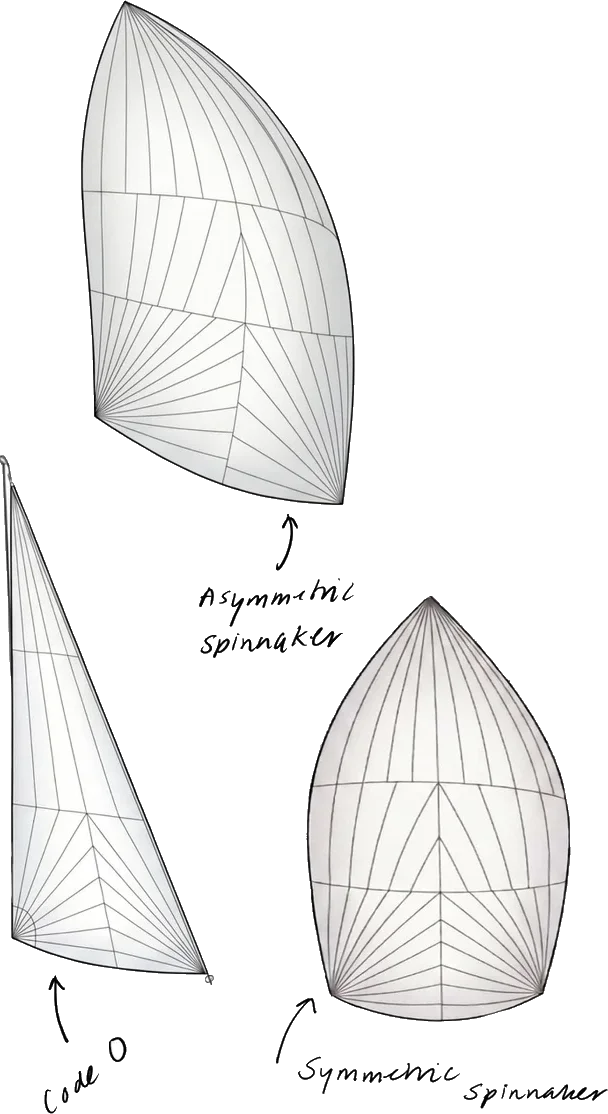
There are three main types of spinnakers (symmetric, asymmetric, and code zero), but we'll cover those in a separate, dedicated article.
5. Storm sails
Storm sails are the sails you hope you never need and absolutely must carry. They're small, heavily built, and designed for survival conditions – when the wind is too strong for even a reefed mainsail and your smallest jib.
The storm jib (also called a spitfire) is a tiny, heavily reinforced headsail, usually bright orange for visibility. It's typically about 5-8% of the boat's total sail area. Its job isn't to make you go fast. Its job is to keep the bow from falling off the wind and keep you making steerable progress in dangerous conditions.
The trysail is a small, loose-footed sail that replaces the mainsail in storm conditions. It's set on the mast but not attached to the boom, so if the boom breaks or becomes uncontrollable, the trysail still works. Like the storm jib, it's about control, not speed. On most offshore races, carrying a storm jib and trysail (or a 50% reefable main) is mandatory – race organisers understand that these sails are the last line of defence before things get genuinely dangerous.
Reefing before storm sails
Before you reach for storm sails, you reef. Reefing reduces the area of your mainsail by lowering it partially and tying off the excess cloth. Most boats have two or three reef points:
- First reef: reduces the mainsail by roughly 20-25%. Your first response when the breeze builds.
- Second reef: takes out about 40-45% of the sail. For when conditions are getting serious.
- Third reef: reduces the mainsail by 60% or more. The last step before dropping the main entirely and going to a trysail.
The old saying is "if you're thinking about reefing, you should have reefed ten minutes ago." It's easier to shake out a reef in a lull than to put one in during a gust.
6. Putting it together – the sail wardrobe
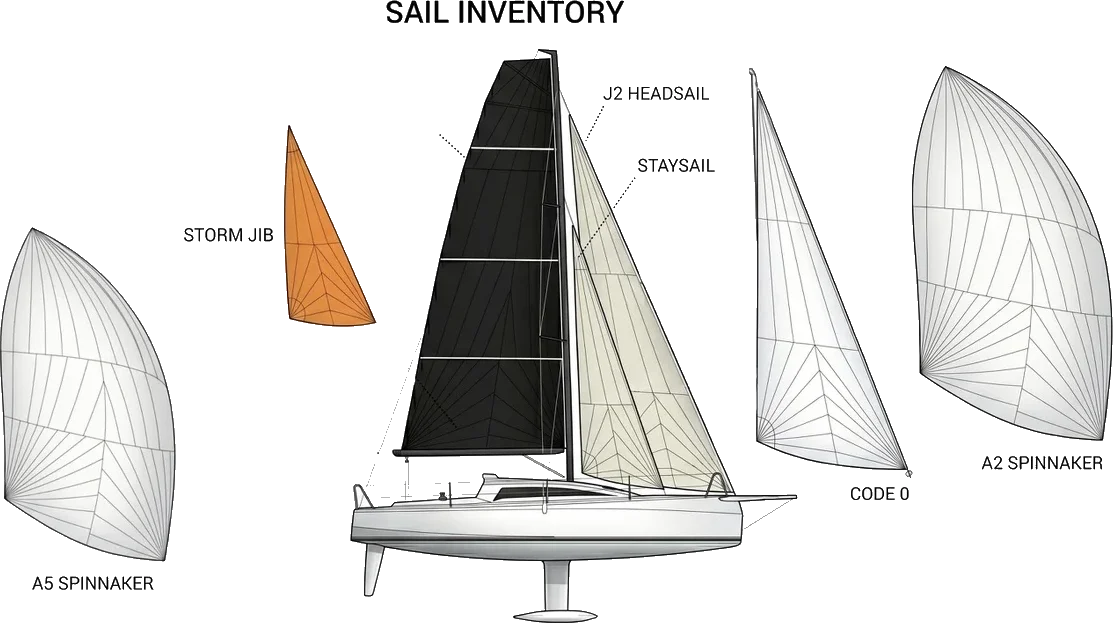
On Alliance, our complete sail inventory for offshore racing is:
- Mainsail – up all the time, three reef points for heavy weather
- Jib – our upwind headsail, which can be reefed to reduce sail area
- Staysail – a smaller, inner headsail we fly when the breeze picks up
- A2: Asymmetric spinnaker – our light/medium running kite – deeper angles, roughly 120°-160° TWA (true wind angle)
- A5: Asymmetric spinnaker – smaller and flatter for heavy air – flown hotter, roughly 110°-140° TWA, and much friendlier to two tired sailors in 25 knots
- Code zero – reaching, 60°-90°, on a furler
- Storm jib – emergency heavy weather headsail
There are also a few specialist reaching sails with nicknames of their own – FROs and jib tops among them – but they're refinements you can leave until later. It's best to first get your head around the mainsail and jib, and then add the specialist sails as your confidence and conditions demand.