A – B
- Apparent wind
- The wind you actually feel on a moving boat – the true wind combined with the breeze made by your own speed.
- Asymmetric spinnaker
- A big downwind sail shaped like a huge, loose jib. Flies from the bowsprit – no pole needed. Sailors name them by size: our A2 is the light-wind one, the A5 the heavy-wind one.
- Ballast
- Weight that keeps the boat upright – lead in the keel, and on Alliance (our race boat), seawater we pump to the high side and empty when it's not needed.
- Beam
- The width of the boat at its widest point. Alliance's is 3.28 m.
- Beating (to windward)
- Zig-zagging upwind toward a point the wind is blowing from, because you can't sail straight into it.
- Bowsprit
- A pole extending from the bow that the big downwind sails fly from.
C – G
- Code zero
- A huge, flat sail that's half genoa, half spinnaker – for sailing closer to the wind than a normal spinnaker can manage. Lives rolled up on a furler (a spool it wraps around).
- Displacement
- The boat's weight (technically, the weight of water it pushes aside). Alliance: 2,800 kg – light for her size, and lighter boats are faster.
- Double-handed
- Racing with a crew of exactly two. Every job on the boat – trimming, navigating, cooking, sleeping – is split between you and one other person.
- Draft
- How deep the boat sits below the waterline – and so the shallowest water she can float in. A deeper keel means more grip and stability. (Of a sail, draft also means the depth of its curve.)
- EAC (East Australian Current)
- The strong current running south along Australia's east coast at 1.5–3 knots. Famous from Finding Nemo; infamous to anyone racing north.
- Genoa / jib
- The triangular sail at the front of the boat. A jib is smaller, a genoa bigger – both are the workhorses of upwind sailing.
- Gybe
- Turning the back of the boat through the wind to change direction while sailing downwind. The downwind partner of a tack.
H – L
- Header / lift
- A wind shift toward your bow (header – forces you off course) or away from it (lift – lets you point closer to where you want to go).
- Heel
- The sideways lean of a sailing boat. Normal, expected, and only alarming the first handful of times.
- Hull
- The body of the boat – the part that keeps the water out. Alliance's is fibreglass.
- IRC / ORC / PHS
- Handicap (rating) systems that let different boats race each other fairly – your finish time is adjusted by your boat's rating. PHS is based on performance history.
- Keel
- The heavy fin under the boat. It stops you sliding sideways and its weight (often a lead bulb) keeps you upright.
- Knot
- One nautical mile per hour (1.852 km/h). Boats, wind, and current are all measured in knots.
- Luff / leech
- The front edge (luff) and back edge (leech) of a sail. The luff is where the wind arrives; the leech is where it leaves.
M – R
- Mainsail
- The big sail on the mast – up almost all the time, and the engine room of the boat's power.
- Mast
- The tall vertical pole/spar that holds the sails up. Alliance's is 14.3 m.
- Nautical mile
- 1.852 km – one minute of latitude. Our two races cover about 900 of them.
- One design (OD)
- A class where every boat is built identical – same hull, keel, rig, sails – so the racing comes down to the sailors, not the chequebook.
- Polars
- A boat's performance model: how fast she should be going at every wind speed and angle. Racing well means chasing those targets.
- Port / starboard
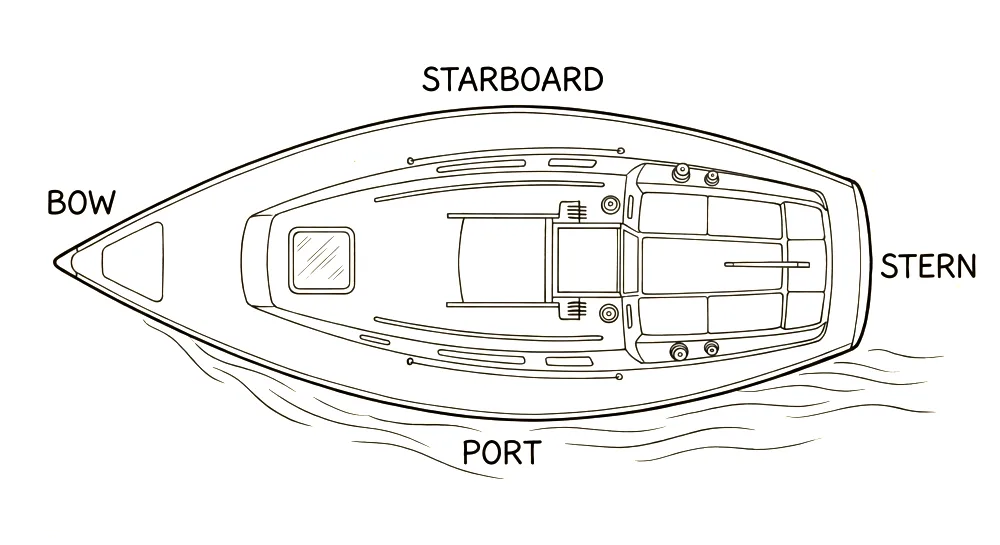
- Left and right, as seen facing the bow (front). Port is left – four letters in both words.
- Reefing
- Making a sail smaller in strong wind – folding or rolling part of it away. Alliance's mainsail has three reef points.
- Rig
- The mast, boom, and all the wires holding them up. Ours is a 14.3 m carbon mast with an aluminium boom and twin backstays (the wires bracing the mast from behind).
S – Z
- Seacock / through-hull
- A hole in the bottom of the boat (through-hull) with a valve to shut it off (seacock) – how seawater gets in for engine cooling and out for drains.
- Short-handed
- Racing with a small crew – one sailor (single-handed) or two (double-handed). Every job a full crew would share falls to far fewer hands, so preparation and autopilot matter enormously.
- Spinnaker
- The big, colourful balloon sail for sailing downwind. Comes in symmetric (needs a pole) and asymmetric (doesn't) flavours. Full guide →
- Staysail
- A smaller, inner headsail flown when the breeze picks up.
- Tack (turn)
- Turning the bow through the wind to change direction while sailing upwind. Also the name for which side the wind is on: port tack or starboard tack.
- Trim
- Adjusting the sails (and the boat) to match the wind – the constant tweaking that separates fast boats from slow ones.
- True wind angle (TWA)
- How far the wind direction sits off the bow: 0° is straight ahead, 180° is dead behind. Every sail has a range of angles it loves.
- Windward / leeward
- The side the wind hits first (windward) and the sheltered side (leeward, said "loo-ard"). Boats, marks, and whole race legs get described this way.